Dead Animal Removal — Finding the Source
A lingering odour in the roof, walls or elsewhere around your home may indicate that a possum or rat has died somewhere within the building. We investigate the likely source, locate the carcass where reasonably possible and remove it where it can be accessed. Diagnosis comes first because the smell alone does not tell you exactly where the source is.
Pricing & booking
Inspection
$382 incl GSTDead Animal Removal — additional charge
From $327 incl GSTSubject to inspection and access. Additional work quoted separately.
Book an InspectionThe Problem You're Experiencing
Most customers reach this page because of a smell they can't locate. These are the situations we hear about most often — described in your terms, before any solution is introduced. Diagnosis comes first.
A lingering odour you can't pinpoint
A persistent, worsening smell is the most common sign that an animal has died in the roof, a wall cavity or under the floor. The source is rarely visible from inside the living space.
Flies or maggots appearing
An increase in flies or the presence of maggots near a particular area can indicate a nearby carcass. The location still needs to be found before it can be removed.
You suspect an animal has died
If you've had noise in the roof that's suddenly stopped, or you've seen an animal enter and not leave, it's reasonable to suspect it has died. An inspection confirms what's there and where.
Signs That Suggest a Dead Animal
These are symptoms — not a diagnosis. Several problems share the same signs, which is exactly why an inspection matters before any recommendation. The source of an odour is not always what you'd assume.
A persistent, worsening odour
A smell that builds over several days and lingers is the hallmark of a deceased animal decomposing in a concealed space. The strength and spread of the odour help narrow the location.
Noise that suddenly stopped
If scratching or movement in the roof has stopped abruptly after being present for some time, it can mean the animal has died. An inspection confirms whether that's the case.
Flies congregating in one area
Flies gathering around a specific part of the ceiling, walls or vents can point to the location of a carcass — even when nothing is visible.
Visible staining or seepage
In advanced cases, fluid or staining may appear on a ceiling or wall near the source. This requires prompt attention to locate and remove the animal and address the affected area.
Symptoms alone don't confirm what's there or where it is. An evidence-based inspection locates the source before any removal is attempted.
Dead Possum or Dead Rat?
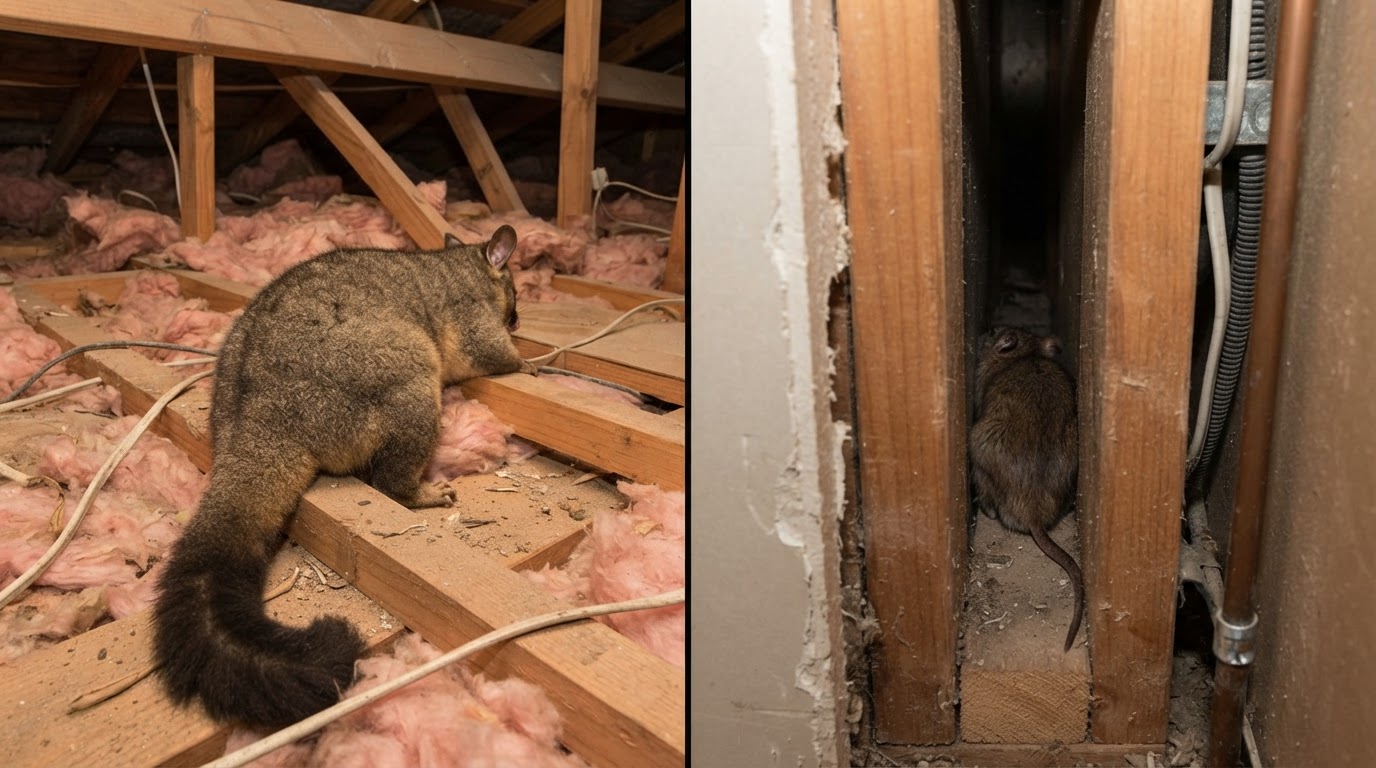
The Possum Man's dead animal removal service specifically covers dead possums and dead rats. Although both can cause unpleasant odours inside a property, there are practical differences that can affect how easily the source can be located and accessed.
Dead Possums
Because a possum is a larger animal, a dead possum will generally produce a stronger and more pungent odour. This can sometimes make it easier to narrow down the general area where the carcass may be located. Possums may die in roof spaces, under buildings or in other areas they have been able to access.
Dead Rats
Rats are much smaller and can move through tighter areas within a building. A rat may therefore die inside a wall cavity, between structural elements or in another confined location that is difficult or sometimes impractical to access. Because the carcass is smaller, the odour from a dead rat will generally be less pungent than the odour from a dead possum. However, the smaller size of the animal and the confined spaces it can occupy can make a dead rat more difficult to locate.
Why Location Matters
Odour can travel through roof spaces, wall cavities and openings within a building. This means the place where the smell is strongest does not necessarily identify exactly where the possum or rat has died. That is why we investigate the available evidence and building structure before determining the likely source and whether the carcass can reasonably be accessed.
Our Dead Animal Removal Approach
The Possum Man uses a systematic diagnostic process. The smell of decomposition doesn't tell you the animal, the location or the access route — so we work through the evidence methodically rather than diagnosing solely from smell.
- Step 1
Listen
We start with what you are experiencing — including where the odour is noticed, when it began, whether it changes in intensity and any other signs you have observed.
- Step 2
Interpret
We consider whether the reported signs are consistent with a dead animal and what those signs may indicate about its possible location.
- Step 3
Investigate
Where an inspection is required, we assess the relevant areas of the property to look for evidence and determine where the source may be located.
- Step 4
Correlate
We consider the odour, location, building structure, insect activity, staining and other available evidence together rather than relying on any single sign.
- Step 5
Diagnose
We determine the most likely source and location and whether the carcass can reasonably be accessed.
- Step 6
Resolve
Where the carcass can be located and reasonably accessed, we remove it and advise you of any relevant next steps.
How Dead Animal Removal Resolves It
Following diagnosis, this is how dead animal removal is carried out — not as a predetermined product, but as an evidence-based resolution that investigates the likely location of the source, removes it where it can be reasonably located and accessed, and addresses the odour.
- Step 1
Locate the source
We start from the diagnosed cause, not an assumption. The inspection traces the odour to the actual location — whether it's the roof, a wall cavity or another concealed space.
- Step 2
Remove where accessible
Where the carcass can be reasonably located and accessed, it is removed safely. In some situations, a carcass may be within a sealed or inaccessible building cavity or another area that cannot reasonably be reached. Where the source cannot be readily located or accessed, further investigation or a different approach may be required.
- Step 3
Address the odour and the access
Affected material is cleaned or treated where appropriate, and odour follow-up is recommended. Removing the carcass addresses the source of the odour, but some residual odour may remain temporarily after removal depending on the circumstances. Where an entry point is identified, sealing it is recommended to prevent recurrence.
Common Questions About Dead Animal Removal
Answers to some of the questions we hear most often about dead animal removal.
Learn More About Odour & Location
Related educational articles to help you understand odour, location and why diagnosis matters. Written from real field experience, not generic pest control copy.
What Scratching in the Roof Really Means
The most common causes of roof noise — and what it means when the noise suddenly stops.
Read articleWhy Possum Exclusion Is the Foundation of Long-Term Possum Control
Why removing an animal without sealing the entry point guarantees the problem returns.
Read articleHow to Tell Possums and Rats Apart by Sound
The noises, timing and location that separate possums from rodents in your roof.
Read articleAsk Kate About Odour & Location
Not ready to book yet? Ask Kate — our Possum & Rodent Diagnosis Assistant, here to help you understand your likely problem before you decide what to do next.
Ask Kate about the smell you're noticing, where it's strongest, and what it might mean. She draws on the same specialist knowledge as our inspectors, so the guidance you get is consistent with everything on this site.
Booking remains the fastest way to get a confirmed location and removal — Kate is here to help you get there with confidence.
Ready to Locate the Source?
Booking an inspection is the natural next step. You don't need to know what animal it is or where it is — that's what the inspection is for. We'll investigate the likely location, remove the carcass where it can be reasonably accessed, and explain what's next.
No pressure, no assumptions — just an evidence-based diagnosis and a clear recommendation. You stay in control the whole way.